
Posted on June 2026 By Icertis HR Tech
| Field | Details |
|---|---|
| Organization | Icertis | Global Contract Intelligence Leader |
| Industry | Enterprise Software (AI-Native SaaS) Contract Intelligence |
| Company Category | Start-up / Emerging Business |
| Global Headcount | 2,000+ employees across 5 countries and 9 offices |
| Offices | Australia, Germany, India, USA & UK |
| Website | https://www.icertis.com |
| Date | June 2026 |
Author: Icertis HR Tech
The Icertis HR Tech team runs the digital side of HR from hire to retire. The team builds on Oracle Fusion HCM across talent acquisition, performance, learning & development, and engagement, giving leaders real-time people data and employees self-service that actually works.
About Icertis: Icertis is the AI-native contract intelligence company that turns enterprise strategy into faster execution at scale. Powered by Vera, the Icertis platform delivers an enterprise-wide contract intelligence layer that understands business and industry context connecting agreements, data, and systems to drive the future of autonomous contracting.
Executive Summary
AI in HR has moved quickly. Three years ago, much of what Icertis was doing looked like rule-based automation. By 2024, it had shifted to GenAI copilots. Today, it is about agents embedded in the tools people already use. For most companies, the question has changed with it. It is no longer whether to use AI in HR. It is how to make AI pay back in measurable business outcomes.
Three Years. Three Generations of AI in HR
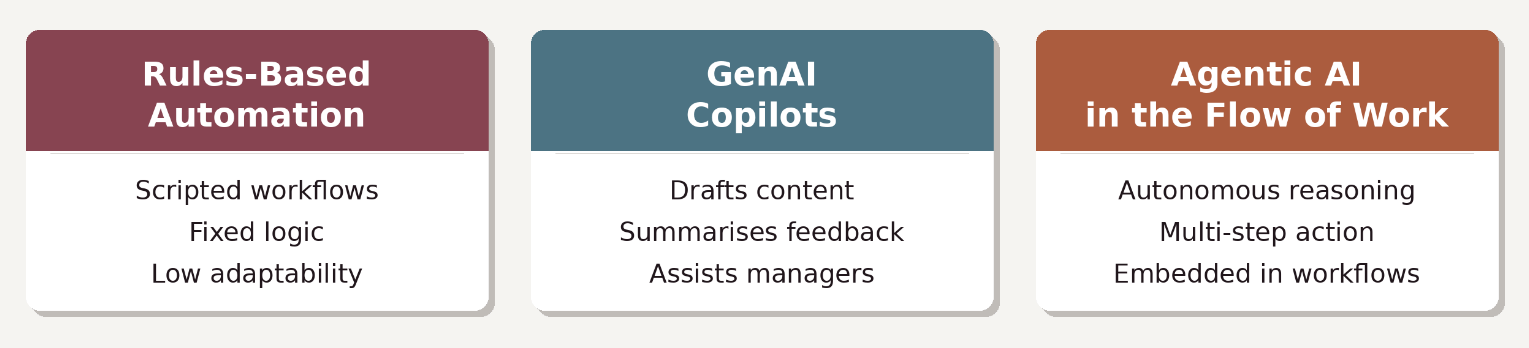
Here is what Icertis did. Starting in 2023, Icertis, the AI-native contract intelligence company with 2,000+ employees across five countries, rebuilt its HR function around Oracle Fusion HCM, enabling AI capabilities across recruiting, onboarding, absence management, talent, skills, skills, feedback, and check-ins. It also connects with AI-enabled platforms such as AVIA (Autonomous Values in Action), the HR chatbot, and VIA, the rewards and recognition platform. The result is one operating model where data, workflows, skills, recognition, and AI all run through the same place.
Culture, recognition, and skills are not separate projects in this model. They are data, sitting in Oracle, feeding the same analytics that track attrition, productivity, and what customers see.
Where Icertis started
By 2022 Icertis had a problem in plain sight. Attrition rate had become a growing concern, and Recognition, the clearest signal of whether people feel seen at work, , the lowest score on that year’s pulse survey. HR itself was running on too many systems, too much manual work, and reporting that always arrived too late.
What Icertis did
Icertis rebuilt HR on Oracle, with AI embedded in the workflow. Oracle Fusion HCM is the single platform where HR data, skills, workflows, and AI come together. The team chose it to eliminate fragmented HR systems and build on an integrated, single-code-base platform with a strong AI roadmap. Over time, Icertis enabled AI capabilities across recruiting, onboarding, absence management, talent, skills, feedback, and check-ins, helping improve processes and ways of working across the HR function. The team added GenAI copilots across the employee lifecycle and positioned recognition as a culture signal, so the appreciation people exchange shows up in the same analytics used for performance and engagement.
What Icertis got, three years in
- Attrition halved over four years, declining every year of the programme.
- Revenue per employee +17% versus 2024 baseline, exceeding the SaaS benchmark of 10–12%.
- Recognition velocity improved 95.8% and volume grew 46%
- Time-to-offer compressed 35% top talent retention reached ~90%.
- HR process savings; 100% audit compliance for 12+ consecutive months.
- Increase in Customer NPS and Net Revenue Retention — evidence that internal experience compounds into external outcomes.
When culture is built into the system people use every day, and AI is used to support human judgment rather than override it, employee experience stops being a soft metric. It starts showing up in the numbers that matter to the business.
The Problem
By 2022, the company was growing fast but the experience inside it was not keeping up. The 2022 Employee Pulse Survey, which had responses from 79% of the workforce, made that gap impossible to ignore: there was a real gap between what Icertis promised customers and what people felt working there.
The numbers told a clear story
People still felt proud and motivated (4.3), but the Empower scores revealed where the experience was breaking down. Career growth and work-life balance stood at 3.9, communication and information access and recognition was the lowest score on the survey, Attrition and eNPS were not catastrophic numbers by industry standards, but they were persistent and they were not improving.
Too many systems, not enough signal
At the time, recognition ran on a SharePoint workflow. It was fully manual, open only to Directors and above, captured around 2,500 appreciations a year, and gave HR nothing useful to analyze. Elsewhere across HR, recruiting was running on 40+ manual offer templates and an 80-day time-to-offer. Onboarding required 30 minutes of HR effort per hire. Goal-setting adoption was stuck at 56%. U.S. benefits updates took a week. India and U.S. payroll ran on spreadsheets.
Three problems sat under all of this:
- Recognition depended on the manager, and it was not linked to the company values. Appreciation rarely tied back to the FORTE values (Fairness, Openness, Respect, Teamwork, Execution), so it did not do much to reinforce the behaviours Icertis needed to scale.
- HR data sat in different places, so the experience felt that way too. People had to move between several systems to get policy answers, raise queries, or find learning. There was no single front door, and the service experience varied by country.
- Reporting was always a month behind. Leaders usually found out about disengagement after it had already turned into attrition. What HR had been monthly look-backs, not anything close to a live signal.
None of this was about perception or leadership. It was a systems problem, and adding another point tool was not going to fix it.
So Icertis changed the question. It was not “how does HR automate recognition?” but “how does HR build one system where culture is something everyone can see, recognition is usable data, skills move as people grow, and the team spots the signal before it becomes a problem?”
How Icertis Built It
Icertis chose to do this at company scale: one HR operating model built on Oracle Fusion HCM, with AI capabilities across recruiting, onboarding, absence management, talent, skills, feedback, and check-ins. It also connects with AI-enabled platforms such as AVIA, the HR chatbot, and VIA, the rewards and recognition platform.
The Oracle Architecture
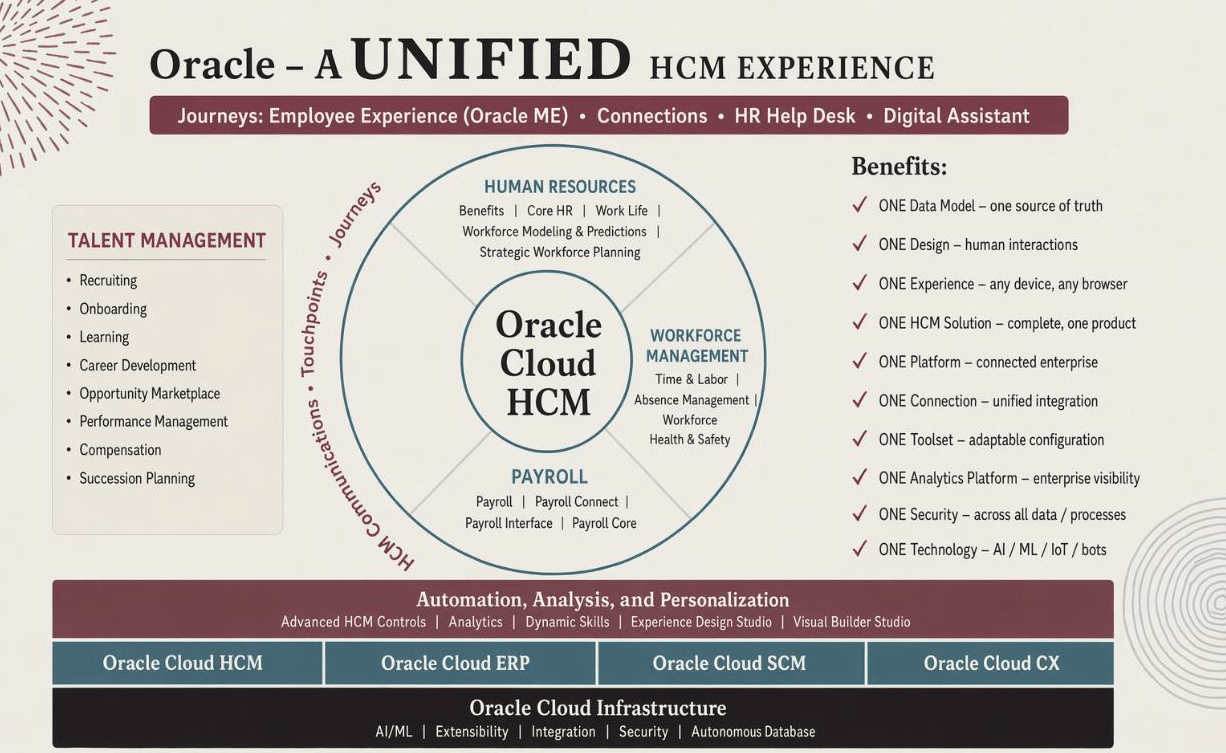
The principles the team worked from
- One platform underneath everything. Oracle Fusion HCM is where Icertis keeps records, but more importantly it is where the team runs intelligence.
- AI agents built with Oracle and placed Oracle workflows inside, rather than bolted on later or run as a separate assistant.
- Talent built around skills, not fixed roles, so the org could move with the work rather than the org chart.
- AI that supports human judgment instead of replacing it, with responsible AI in place from day one.
Oracle Fusion HCM, the source of truth
Why Oracle. Icertis evaluated several options. Most HR transformations stall not because individual tools are weak, but because data, workflows, AI, and employee experience sit in different places and never fully align. Oracle Fusion HCM gave the team one place to bring them together. Its integrated architecture and single code base support the full hire-to-retire lifecycle, while AI and analytics operate on the same data they govern. The platform is also open enough for
Contact us: icertis.com/contact 5 Icertis to build 40+ interfaces that connect with other AI platforms as well as Finance and IT systems. That made the decision architectural, not simply vendor driven. Every later investment, including agents, copilots, skills, and recognition, builds on the same data foundation and compounds over time.
Oracle Fusion HCM is what holds the rest together. It gives Icertis one global source of truth across all HCM modules and the third-party systems connected to it. The team rebuilt the processes around current best practices rather than lifting and shifting the old ones. Every HR transaction, skill, signal, and workflow either lives in Oracle or moves through it. The choice Icertis made was to treat the platform as a place where intelligence runs, not just where records sit, with AI, analytics, and engagement signals running across Core HR, Recruiting, Onboarding, Performance, Learning, Benefits, and Payroll.
On 21 April 2025, Icertis became the first enterprise in India to go live on Oracle Fusion Payroll. The system cleared audit compliance from the very first run, which gave the team early confidence that the foundation could hold up under real scrutiny.
AVIA (Autonomous Values in Action), the HR Chatbot
AVIA, Icertis’s AI-powered HR chatbot, is an autonomous agent that uses retrieval-augmented generation to respond to HR-related queries. When it cannot resolve a request, it automatically creates a ticket for HR support. It serves employees through recruiting, onboarding, learning, performance, benefits, and payroll, and is fully integrated with Oracle HCM.
How it works
Understanding context: AVIA interprets the context of each employee query and routes it to the appropriate action without relying on predefined intents. It also carries forward conversation history, making the experience more natural and conversational.
Knowledge management: AVIA can draw answers directly from enterprise knowledge sources, using context to interpret employee questions without the manual intent design previously required. This improves both accuracy and scalability as knowledge evolves.
Copilots inside the workflow, and a live view of skills
Inside Oracle Fusion HCM, GenAI Assist synthesizes feedback into coherent performance evaluations, saving 30%+ of manager time while improving comment quality. AI Assist drafts culture-aligned candidate communications in Oracle Recruiting. AI-powered JD authoring helps hiring managers create structured, inclusive job descriptions. AI Benefits Analyst handles eligibility in real time, while predictive analytics flag payroll anomalies before finalization.
Dynamic Skills extracts capabilities from resumes, LinkedIn profiles, and internal performance signals enabling skills-first hiring, real-time internal mobility, and personalized learning. The Skills Centre captured 5,127 developing skills across 400 employees in its first year.
Recognition wired into the same analytics
Recognition is not a separate program at Icertis. It is a culture signal that lives inside Oracle. Appreciation events get captured through Vantage Circle, with the Vantage Circle Agent for Microsoft 365 Copilot nudging managers and peers in Teams when there is a moment worth recognizing. Those events sync daily into Oracle Fusion HCM and flow into performance, engagement, and attrition analytics. Each recognition is tagged to a FORTE value, which gives Icertis leaders behavioural data they can look at next to skills, performance, and retention. Culture stops being a story the company tells. It becomes data leaders can look at in the same place as the rest of HR.
Responsible AI from the start
Governance was a day-one requirement, not a later add-on. That means transparency in how recommendations are made, bias mitigation in candidate scoring and performance tooling, human-in-the-loop checkpoints for consequential decisions, and Zero Trust security with continuous verification across HR data. The principle is simple: AI scales fairness and speed. Humans stay accountable for decisions that affect people’s careers, pay, and wellbeing.
Three years in, HR at Icertis runs on one platform instead of a dozen, and it spends more time on judgment than on transactions.
AI agents that work
AVIA is an agent, not a scripted chatbot. It uses retrieval-augmented generation to respond to HR-related questions across recruiting, onboarding, performance, learning, benefits, and payroll. When it cannot resolve a query, it automatically routes the issue to HR for human support. Fully integrated with Oracle HCM, AVIA gives employees fast access to information while reducing transactional workload for the HR team.
The Vantage Circle Agent for Microsoft 365 Copilot brings the same agent pattern into recognition inside Teams. Between them, these agents give Icertis a personal experience at company scale, and they take a real chunk of transactional work off HR.
AI Capability Architecture
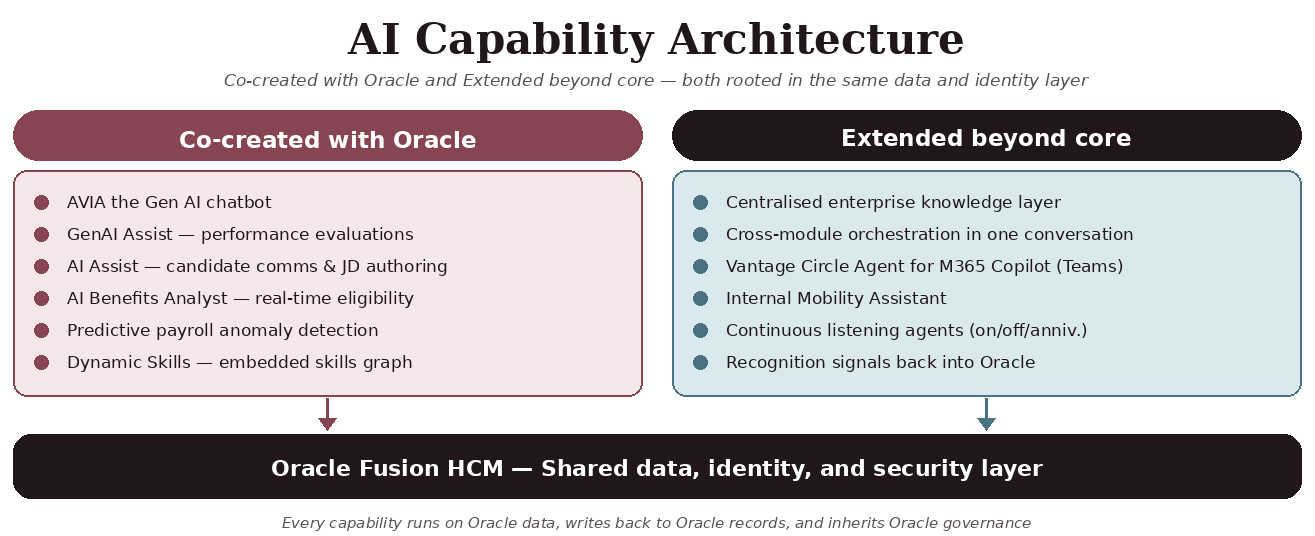
AI capability architecture — capabilities co-created with Oracle and those extended beyond core, both rooted in the Oracle Fusion HCM data and identity layer.
Copilots that save managers time without taking over the call
Inside Oracle workflows, GenAI Assist helps managers synthesise feedback into fair, consistent performance evaluations saving 30%+ of manager time. AI Assist drafts candidate communications in Oracle Recruiting; AI-powered JD authoring produces structured, inclusive job descriptions; Recognition Guide and Smart Comments raise the floor on peer appreciation quality. Each copilot is embedded where the work already happens — compressing effort, improving consistency, and freeing managers and HR partners for judgment-heavy work.
Skills, predictions, and listening
Dynamic Skills builds a living, machine-curated skills graph from resumes, LinkedIn, and internal performance signals enabling internal mobility, learning recommendations, and workforce planning. Real-time analytics expose recognition patterns, attrition signals, and skills coverage by region, function, and level allowing leaders to spot blind spots proactively. Predictive models flag payroll anomalies variance spikes, missing timecards, tax inconsistencies before finalization. Continuous employee listening through onboarding, offboarding, and anniversary surveys converts sentiment into early-warning signals on attrition risk and managerial effectiveness. AI here is positioned as decision intelligence, not retrospective reporting.
Why Icertis kept it all on one stack
Recognition, performance data, skills, learning, and engagement signals all live in or pass through Oracle Fusion HCM. Vantage Circle syncs into Oracle daily, so recognition data flows directly into performance and engagement reporting. Keeping everything on the same stack is what turns individual AI features into a system that becomes more valuable over time.
What Changed in the Business
What makes this story useful is that the outcomes are measurable, sustained over time, and visible in business results, not just HR metrics.
Change, in one view
| Metric | Change |
|---|---|
| Attrition | ↓ 50% |
| Revenue per Employee | ↑ 17% |
| Customer NPS | ↑ 64% |
| Top Talent Retention | +5 pts |
| Recognitions (Badges & Awards) | ↑ 46% |
| Recognition Response Time | ↓ 95.8% |
| Time-to-Offer | ↓ 35% |
| Hiring Manager CSAT | +21% |
| Onboarding Effort (HR time) | ↓ 93% |
| Goal-Setting Adoption | +39 pts |
| Performance Appraisal Completion | +16 pts |
| Learning Adoption (≥1 training) | ↑ 71% |
| Benefits Enrolment Time | ↓ 99% |
| Annualized HR Process Savings | Realized |
People stayed, and the culture lifted
- Attrition halved (~24% → ~12%) over four years, declining every year of the programme.
- Top talent retention reached ~90% versus an ~85% industry benchmark.
- Recognition volume grew 46% YoY; average response time compressed from 24 hours to 1 hour.
- Work-anniversary sentiment lifted overall, and for manager sentiment.
- Exit “would you return?” sentiment rose which is an unusual signal of culture durabilit
Hiring got faster, and onboarding got easier
- Time-to-offer compressed 35%
- Hiring manager CSAT rose (+21%); candidate experience (Glassdoor) rose 62% → 76%.
- Diversity hires reached 30% versus the ~25% benchmark; candidate quality went up 7%.
- Agency spend reduced 96%; contingent workforce down 36%; background-verification turnaround compressed from 15–20 days to 2–5 days.
- Onboarding HR effort dropped 93%; onboarding satisfaction increased.
Productivity, learning, and skills
- Goal-setting adoption surged from 56% to 95%; performance appraisal completion reached 96% (all-time high).
- 71% of employees completed at least one training session annually; LinkedIn Learning adoption hit 42% versus 24% industry average.
- Training NPS rose; compliance training completion reached 95%.
- Skills Centre captured 5,127 developing skills across 400 employees in year one.
Operations, compliance, and the business numbers
- Benefits enrolment compressed from 2–3 days to 5 minutes; payroll cycle shortened 30%.
- HR process savings; 100% audit compliance for 12+ months.
- First enterprise in India to go live on Oracle Fusion Payroll (21 April 2025) with full audit compliance from the first run.
The pattern that matters most is what happened on the customer side. The internal numbers improved first; the customer numbers followed. Culture, it turns out, does not stay inside the building.
What Icertis Would Pass On
If a company is setting out on a similar journey, five things stand out from the Icertis experience.
1. Start from your culture, not a feature list. The team tested every choice, inside Oracle and inside AVIA & VIA, against the FORTE values (Fairness, Openness, Respect, Teamwork, Execution), not against a vendor roadmap. Before you look at any platform, get clear on the cultural non-negotiables your AI must reinforce. AI without that anchor just speeds up transactions. AI with it produces behaviour change you can actually measure.
2. Open it up to everyone and obsess over the experience. Removing the “Directors-and-above-only” gate made a real difference, but only because what Icertis put in its place was easy to use: SSO, mobile, native to Teams, agent-prompted, and built into Oracle. Opening it up without making it simple just creates noise; making it simple but not open to everyone leaves people out. You have to do both.
3. Integrate end to end. Remove the workarounds. Keeping everything on one stack, with Oracle Fusion HCM, AVIA, VIA, copilots, recognition, and skills all contributing to the same analytics, was one of the most important design choices Icertis made. It eliminated manual reconciliation, reduced budget mismatches, and downstream errors, and helped with annual savings. Manual workarounds erode trust faster than missing features do.
4. Measure recognition like you measure anything else that matters. Icertis tracks recognition velocity, peer-interaction patterns, sentiment signals, attrition leading indicators, revenue per employee, and customer NPS as one connected set of metrics inside Oracle. Recognition is real data at Icertis, not a feel-good metric. Decide upfront what success looks like, both in numbers and in stories, and build your reporting alongside the rollout, not after it.
5. Put the same effort into change management as you put into the tech. The launch worked because Icertis treated it as a cultural moment, not a software rollout: communications across multiple channels, visual teasers, manager enablement, and focused training. A rough rule of thumb that worked for the team: plan 30 to 40 percent of the budget and timeline for change management and keep telling people the why.
What needs to be true for this to work
- Real sponsorship from your CHRO and CEO for what you are doing with AI.
- Values your people actually use day to day, not just ones you publish.
- Willingness to redesign the process rather than digitise a broken one on the new platform.
- Mixed teams of HR, IT, and data people, and an HR function ready to spend less time on admin and more on advice.
- Patience: culture and AI investments compound. The returns show up in years, not quarters.
Where HR Is Heading
What Icertis has seen lines up with a broader shift happening in HR across companies: AI, skills, and experience pulling together into one operating model.
Programs become platforms
Recognition, learning, performance, and onboarding stop being separate programmes and start showing up as features inside one platform. What you design for shifts from individual workflows to the overall experience.
Transactions give way to better decisions
What HR delivers shifts from running the process to helping the business make better calls: catching attrition risk before it becomes attrition, skills gaps before they become bottlenecks, and disengagement before it becomes a resignation.
Talent moves with skills, not job titles
Dynamic skills, mobility assistants, and AI-driven learning recommendations shift talent strategy toward what people can do and what they want to do next, rather than the job description they were hired into.
HR shifts from cost line to value driver
Once culture lives inside the system and recognition becomes a measurable signal, HR stops being a cost conversation and starts being a value conversation. The Icertis numbers, customer NPS lift, and attrition cut in half, are the clearest evidence of this shift.
Over the next five years, HR will be defined less by the tools it selects and more by how effectively it brings AI, skills, and experience into one operating model for a workforce where humans and AI work together. Humans remain accountable for decisions that affect careers, pay, and culture. AI scales consistency, speed, and fairness.
Plenty of companies are walking this road. What Icertis offers is a working example of where it leads, and an answer to the question most CHROs are wrestling with today: how can AI show up in business results, not just HR dashboards?