
Posted on 30th April 2026 By Nachiket Khare
This whitepaper is on integrating behavioural science and AI to individual, team and organisation effectiveness, improve hiring and performance outcomes leveraging AI.
Whitepaper Outline:
- Why behavioural data is critical in modern HR
- How frameworks like Belbin make behaviour measurable
- How AI can scale and apply these insights
- Real examples of impact across hiring, team design, and leadership
Who This Is Relevant For:
This paper is particularly relevant for:
- CXOs, driving AI adoption
- CHROs looking for creating collaborative culture within the organisation
- Talent acquisition leaders looking to improve quality of hire
- Business leaders responsible for team performance
- OD and L&D professionals focused on behavioural change
Executive Summary
Organisations today are investing heavily in AI across HR—from hiring to engagement to workforce analytics. While this has improved efficiency, it has not solved a more fundamental problem: Why do capable individuals and teams still underperform?
The answer lies in a missing layer of data—human behaviour.
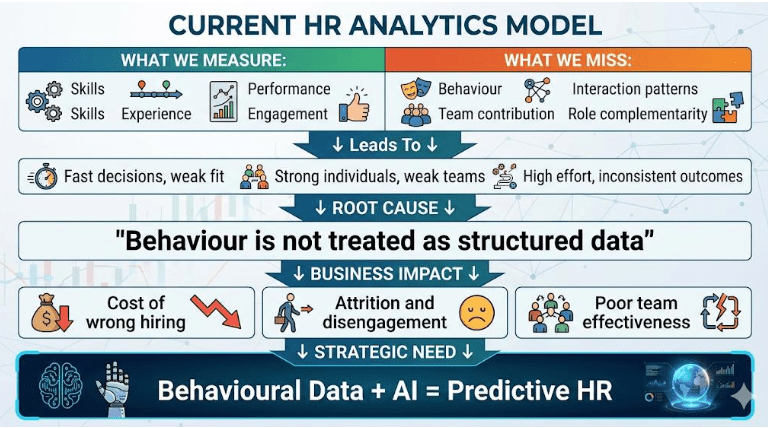
Most HR systems capture skills, experience, and performance. However, they do not systematically capture how individuals behave and contribute to a situation and team settings, how they initiate, collaborate, or execute. As a result, AI is often applied to incomplete data, improving speed but not the decision quality.
A simple example illustrates this. A capable team consistently failed to complete projects—not due to lack of skill, but due to absence of behaviours that drive closures with a good degree of perfection. A single hire with that behavioural strength shifted execution across the team.
Behaviour, when measured, becomes data. When combined with AI, it becomes predictive.
This approach enables organisations to:
- Get individuals to play to their strengths
- Collaborate and build more effective teams
- Improve quality of hiring decisions
- Reduce early attrition
The core message is straightforward: AI in HR will only be as effective as the data it is built on—and behavioural data is the missing data layer.
“The future will not belong to organisations that simply adopt AI. It will belong to those that combine AI with deep behavioural insights.”
AI does not fail in HR because of technology limitations—it underperforms because it is not fed the right data. Behaviour is that missing data layer.
Organisations that recognise this—and integrate behavioural science with AI—will move from:
- Reactive decision-making → Predictive insights
- Individual optimisation → Team effectiveness
- Data abundance → Decision clarity
The Innovation Frontier: Scalable Intuition
True innovation in HR is not limited to the speed of processing, but the conceptual transformation of data. By integrating structured behavioural frameworks, organisations pioneer a model of Scalable Intuition—where AI moves beyond clerical efficiency to become a strategic orchestrator for performance. This shift allows for the intentional design of high-performance cultures, moving HR from digitising historical records to architecting future synergy with machine precision and human depth.
The Business Challenge
Why the Future of HR Analytics Requires Behavioural Data
We are living through a fundamental shift in how work gets done—and how organisations make people decisions.
Artificial Intelligence is now deeply embedded across the HR value chain. From screening candidates to predicting attrition, from analysing engagement to enabling workforce planning—AI has significantly improved efficiency and brought a new level of analytical sharpness to HR.
And yet, despite all this progress, something important is still missing.
Human behaviour.
This is not a small gap—it is the core gap.
The Blind Spot No One Is Solving
Human beings do not behave like linear systems. They don’t follow rules, consistently! They contradict themselves. They respond to emotions, past experiences, fear, motivation, values, and this may change with the context. The same individual may behave differently across teams, situations, or leadership environments.
And yet, if you step back, patterns do exist.
The challenge is not that behaviour is random. The challenge is that we have not been capturing it in a structured way.
This creates a fundamental contradiction in modern HR: We are using AI—one of the most powerful tools for prediction—without feeding it the most critical variable required for prediction: behaviour.
In many ways, predicting human behaviour is one of the hardest problems in data science. And yet, this is exactly what determines whether teams succeed or fail.
The Puzzle Leaders Are Facing
This gap shows up very clearly in day-to-day leadership decisions.
Organisations today are not short of data. In fact, they are overwhelmed with it—engagement scores, performance ratings, skills inventories, attrition models. The dashboards are richer than ever before.
But the questions that matter remain difficult to answer:
- Why does a high-performing individual suddenly fail when placed in a new team?
- Why does a strong hire struggle to integrate despite being “perfect on paper”?
- Why do organisations lose top talent even when everything seems right externally?
These are not questions about skills or experience. These are questions about behaviour in context. And this is where current HR analytics—and even AI—starts to fall short.
Why This Gap Is Strategic and Not Incidental
The impact of this gap is not incremental—it is significant.
Research from a survey of Gallup1 shows that teams in the top quartile of engagement outperform those in the bottom quartile by:
- ~23% in profitability
- ~18% in sales productivity
- ~14% in operational productivity
What this tells us is simple but powerful: The difference between average and high performance is not just capability—it is how people contribute and work together.
In other words, performance is increasingly a team outcome, not an individual one.
The Missing Layer: Identifying Behaviour as Data
For AI to work effectively, it requires data—and more importantly, the right kind of data.
Today, organisations are very good at capturing:
- What people have done
- What people have achieved
But they are far less equipped to capture:
- How people behave
- How they contribute
- How they respond to pressure, ambiguity, and others
This is not because behaviour cannot be measured. It is because measuring behaviour requires a different kind of instrument—one that most organisations have not systematically adopted.
As a result, behaviour remains:
- Subjective
- Inconsistently assessed
- Difficult to scale
What This Leads To in Practice
When behaviour is not treated as data, the consequences are predictable. Hiring becomes faster, but not necessarily better. Teams are formed but not intentionally designed. Performance is measured after the fact but rarely predicted in advance.
1 https://www.gallup.com/workplace/236366/right-culture-not-employee-satisfaction.aspx
This is why organisations continue to face:
- Costly mis-hires
- Team friction despite strong individual talent
- Cultural misalignment
- Inconsistent performance across similar teams
The Core Problem
The Shift That Is Required
At its core, the shift required is conceptual. Organisations need to move from asking:
“Can this individual do the job?”
to asking:
“How will this individual behave and contribute in this role, within this team, and in this environment?”
Until that shift happens, AI will continue to optimise efficiency—but not effectiveness.
The AI Solution
Closing the Behavioural Data Gap with Belbin
To solve this problem, organisations do not need to reinvent behavioural science. They need to use a framework that already captures behaviour in a structured, scalable way—and then combine it with AI.
This is where Belbin becomes highly relevant.
Why Belbin Works as a Data Foundation
There are several behavioural and psychometric tools available today. However, most of them are designed for individual insight, not for understanding individual and team chemistry dynamics.
Belbin is different in one important way: It was designed to understand how individuals contribute within teams—and how those contributions impact performance.
Belbin Interplace i8 and In2teams2, behavioural data is doing what AI is trying to do:
- Identify patterns
- Predict outcomes
- Improve decisions
What Makes Belbin Particularly Powerful
First, it does not rely only on self-perception. Belbin incorporates observer feedback, which means the data reflects not just how individuals see themselves—but how they are experienced by others.
This significantly improves reliability.
Second, it is grounded in decades of research, which means the patterns it identifies are not anecdotal—they are consistent and repeatable.
Third, it is highly practical. The output is not abstract personality labels, but clear insights on:
- Strengths
- Allowable weaknesses
- Contribution to teams
Finally, it provides a common language that can be used across hiring, team design, and leadership development—making it scalable at an organisational level.
Where AI Comes In
Once behaviour is captured in a structured way through Belbin, AI can significantly extend its value as currently being done in Belbin Interplace i8 and In2teams systems.
2 Name of the Software developed by Belbin®
The innovation in Interplace i8 and In2teams is about analysing patterns across teams and identify what combinations of behaviours lead to better outcomes. It can highlight mismatches between role demands and natural working styles. It can also flag potential friction points within teams—often before they become visible. The innovation in AI is not about the system but the research supporting the AI system.
Results and Impact
To explain as how Belbin is being used in organisations, I would like to share 5 real life case studies.
Case Study 1: AI-Driven Behavioural Optimisation for a Global ITeS provider
A global ITeS provider faced friction within its multicultural virtual teams due to behavioural misalignments. The organisation required a scalable, digital-first solution to optimise collaboration.
The organisation leveraged Belbin Team Roles as a more proactive operational tool.
Belbin Team Reports suggested optimal team balance, predicting or indicating potential challenges / warnings for the team
Key Impact:
- Lower Friction
- Faster Decision-Making
High performing teams by pivoting through predictive behaviour
Case Study 2: Strategic Organisation Performance leveraging Belbin
To fuel growth, a leading organisation serving airlines, transitioned from traditional profiling to a continuous behavioural journey using the Belbin framework. The program utilised 360-degree assessments and leadership coaching to embed a shared behavioural language across the organisation.
Key Impact:
- Balanced Teams: Enabled the intentional design of cross-functional teams that leverage complementary strengths
- Leadership Adaptability: Managers shifted from rigid expectations to inclusive governance after identifying diversity in team thinking.
- Collaborative Culture: Shared insights reduced interpersonal friction and improved productivity, turning “difficult people” conversations into discussions on role gaps.
- Scalable Engagement: The initiative sparked fresh engagement routines, such as unit heads conducting one-on-one “tea conversations” with all staff levels.
High performing teams by pivoting through predictive behaviour
By treating behaviour as a strategic data point rather than an HR tool, this organisation achieved a transformation where the spirit of collaboration is now a visible as a key business driver.
Transformation from reactive management to behavioural diagnostics leading to better collaboration
Case Study 3: From Awareness to Action in a Mid-Sized IT Firm
A mid-sized IT organisation was grappling with three interconnected challenges—lack of self-awareness, inconsistent team collaboration, and uncertainty in hiring for senior roles.
Belbin was introduced as a common behavioural framework across the organisation.
Impact:
- Developmental Shift: Utilised structured self and observer feedback to pivot from assumption-based to insight-driven professional growth
- Collaborative Precision: Transformed “personality-based” conflicts into objective discussions regarding behavioural roles and team gaps
- Hiring Objectivity: Calibrated senior-level recruitment (Project Managers and above) by assessing behavioural suitability alongside traditional technical experience
The result was not just better decisions—but more confident decisions.
Case Study 4: When the Real Problem Was Not Capability
In another instance, a team consistently struggled to complete projects. The issue was not capability—the team was experienced, driven, and collaborative.
Yet projects kept stalling.
A Belbin team analysis revealed a clear pattern. The team had strong “starter” behaviours—ideas, drive, energy—but lacked “finisher” behaviour.
This insight was both simple and powerful.
Around the same time, the organisation was hiring for a Personal Assistant role. The candidate, when assessed through Belbin, showed a strong Completer Finisher profile.
Transformation from reactive management to behavioural diagnostics leading to better collaboration
The result was not just better decisions—but more confident decisions.
Despite initial hesitation (given the role was not seen as strategic), the organisation went ahead with the hire. The impact was immediate. Projects that previously stalled started getting completed.
Follow-through improved. Deadlines were met.
Performance Gaps are often behavioural and sometimes one role can shift the entire system
Case Study 5: Improving Recruitment Outcomes at Scale
A large IT services organisation dealing with high-volume hiring faced a familiar problem—quality inconsistency and early attrition.
Belbin was integrated into the recruitment process, not as a standalone tool, but as a layer that complemented existing assessments.
Candidates were evaluated not just for role fit, but for team fit. Behavioural profiles were mapped against team requirements.
This small shift—from hiring for role to hiring for team—led to the following impact:
- Better onboarding experiences
- Improved alignment and fitment
- Reduced early attrition
Performance Gaps are often behavioural and sometimes one role can shift the entire system
Recruitment changed to an engine for alignment
What Organisations Typically Don’t Expect
When organisations begin using behavioural data with AI, three things tend to surprise them.
First is the accuracy. Patterns that were informally observed suddenly become visible and validated with clarity.
Second is where the impact comes from. It is not always senior roles—sometimes a single behavioural gap, at any level, drives performance outcomes.
Third is the speed of change. Once behavioural alignment improves, results tend to follow faster than expected.
The Real Implication
Many organisations today are investing heavily in AI for HR.
But there is a fundamental risk: If behavioural data is missing, AI will improve speed—but not decision quality.
The more important question, therefore, is not: “How do we use AI better?” It is: “What data are we giving AI to work with?”
Closing Thoughts
The organisations that will truly benefit from AI in HR will not be the ones that adopt it fastest.
They will be the ones that:
- Understand behaviour deeply
- Capture it systematically
- And use AI to act on it intelligently
On a final note: Only AI does not transform HR. Better understanding of people does. AI simply makes that understanding scalable.
The future will not belong to organisations that simply adopt AI, it will belong to those that combine AI with deep behavioural insights!