
Posted on 30th April 2026 By LTM HR Transformation Team
| Organisation | LTM Limited |
| Website | www.LTM.com |
| Business Type | IT Services and Consulting |
| Size Category | Large Business (global turnover above ₹10 Crore; headcount above 150) |
| Headcount | 87,000+ associates |
| Offices | 117 offices across 41 countries |
| Submitted by | LTM HR Transformation Team |
| Date | 30th April 2026 |
This whitepaper documents LTM’s journey of transforming HR using AI, detailing how the function moved from fragmented, transactional operations to an AI-enabled, insight-driven model that now serves both internal needs and external clients. It provides a practical account of what was attempted, what worked, what did not, and what other organisations can learn from this experience.
Intended audience: CHROs and HR leaders seeking examples of AI-led transformation at enterprise scale; transformation teams looking for replicable frameworks.
1. Executive Summary
The Challenge
After the 2022 merger of LTI and Mindtree, LTM’s HR function operated across 87,000+ employees in 117 offices spanning 41 countries. HR systems were fragmented across platforms, manual effort was high, insights arrived too late, and employee experiences were inconsistent. Traditional HR platforms could not deliver the speed, consistency, or proactive support the organisation needed.
The AI Solution
LTM set out with a clear objective: to become a case study for customers. The approach was not to replace HR with AI, but to empower HR professionals by standardising employee experiences and strengthening decision-making, while ensuring that human judgement, trust, and robust governance remained central to all decisions affecting careers, compensation, and wellbeing. Two flagship capabilities were deployed:
- RAIma (HR Super Agent): A single conversational interface covering the entire hire-to-retire lifecycle, integrated with enterprise platforms to transform fragmented workflows into proactive, end-to-end employee support.
- AI across eight HR domains: Talent Acquisition, HR Service Delivery, Employee Experience, Performance Management, Compensation, Compliance, Analytics, and Learning and Development, with AI capabilities integrated into existing workflows rather than deployed as standalone tools.
Key Outcomes
- 21% improvement in overall HR productivity (validated by HR leadership).
- 165+ HR workflows redesigned to reduce manual effort and follow-ups.
- 141 AI use cases live across HR, supported by 33 active agents.
- 500,000+ queries resolved with 75% positive satisfaction.
- 6 packaged HR AI offerings launched for external clients, influencing large deals and consulting engagements.
- 8 HR Transformation Awards including Brandon Hall Gold and SHRM Gold, with case studies published by Microsoft and ServiceNow.
Who should read this: CHROs and HR leaders seeking enterprise-scale AI examples, and HR transformation teams looking for replicable frameworks.
2. The Business Challenge
Industry Context
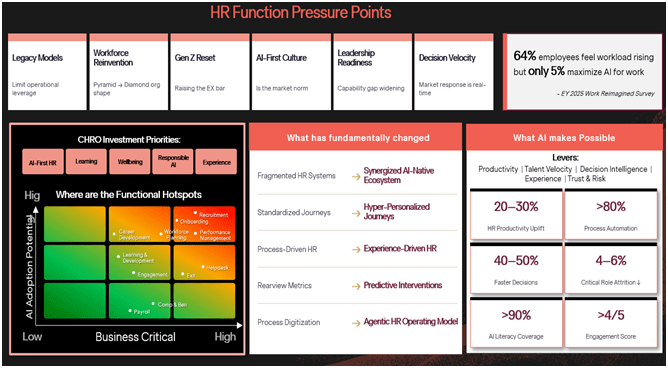
Over the past few years, HR expectations have shifted sharply. Employees now expect HR support to be instant, digital, and simple. Leaders expect HR to move faster: from answering questions to enabling decisions. At the same time, organisational structures are changing. Traditional pyramids are flattening into diamond-shaped workforces, leading to an increase in the volume of HR interactions and decisions.
Mercer describes the world of work as being in ‘full metamorphosis,’ driven by human-machine teaming, and emphasises that real gains come only when people remain at the centre of transformation. As a result, HR functions across industries have been investing in integrating AI into core systems, building skills infrastructure, automating high-volume operations end-to-end, embedding trust and compliance guardrails, and improving employee experience at scale.
The LTM Context
Post-Merger Scale and Workforce Shape
Born from the 2022 merger of LTI and Mindtree, LTM operates with 87,000+ associates across 117 offices in 41 countries. The business depends on speed, agility, and talent mobility, making HR complexity structural: policies vary by country, service delivery spans time zones, and consistency becomes harder as volumes increase.
What makes LTM’s workforce distinctive is its demographic shape. The employee base is young in tenure and large in volume, with over 40% Gen Z employees bringing new ways of working and evolving expectations. The organisational pyramid is mid-to-junior heavy, with far more people in Levels 1 to 4 than in senior leadership. This creates a different kind of demand: employees need frequent guidance, managers need structured prompts, and HR must run cycles (onboarding, policies, performance, learning) at industrial scale.
The operational evidence is clear:
- LTM’s digital onboarding platform processes between10,000 to 12,000+ new hires annually, executing 200,000+ onboarding tasks and 78,000+ exit tasks per year.
- RAIma handled around 97,000 queries in its early months, averaging 300 to 400 questions daily, alongside 30,000+ policy searches in the first month of the AI-powered policy portal.
Fragmented Systems Across the Employee Lifecycle
The existing HR systems were not employee-friendly. During the onboarding journey, employees navigated different tools for recruiting, onboarding, policies, service desk, performance, learning, and offboarding. Multiple handoffs caused by a plethora of platforms made the system feel broken. HR systems existed, but the journey felt scattered.
High Manual Effort in HR Operations
Before transformation, much of HR work was manual and follow-up heavy:
- Recruiters spent significant time screening resumes, coordinating interviews, and following up with candidates and hiring managers, leaving less time for quality conversations and workforce planning.
- Onboarding teams managed joining journeys through emails, spreadsheets, and manual handoffs, which often led to delays, missed steps, and inconsistent experiences for new hires.
- HRBPs and performance teams found themselves repeatedly following up with managers and employees to set goals, complete reviews, or close cycles.
- Employee queries accumulated in HR inboxes, with similar questions being answered repeatedly, slowing response times and frustrating both employees and HR teams.
As volumes grew, this way of working became difficult to sustain, leaving HR teams stretched, reactive, and focused on transactions rather than impact.
Reactive, Lagging Decision-Making
Leaders and HR teams often received insights after issues had already become problems: attrition signals, disengagement, process delays, policy confusion. The need was to shift to predictive insights and real-time visibility, rather than after-the-fact reporting.
3. The AI Solution
Vision and Strategic Approach
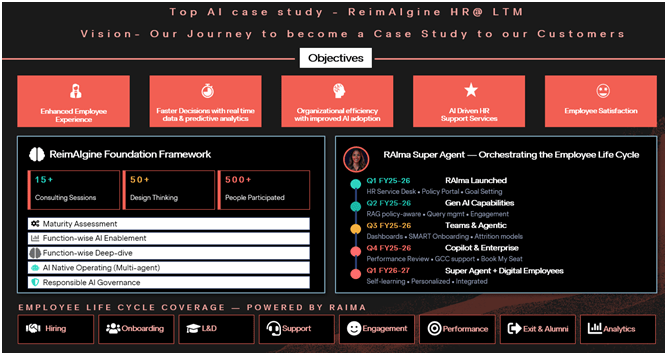
The transformation started with a clear vision: to become an AI case study for customers. This was not an internal-only initiative; it was designed from the outset to be replicable, scalable, and customer-ready. Three objectives anchored the programme:
- Build an AI-native HR operating model.
- Achieve measurable impact on efficiency, experience, and decision quality.
- Create a foundation strong enough to become a consulting offering.
Building the Foundation
Maturity assessment: LTM conducted a comprehensive maturity assessment to understand where the organisation stood, identifying areas that were ‘AI intent-rich but AI-poor’ and where readiness was highest.
Function-wise enablement: Each HR function (Talent Acquisition, HR Service Delivery, Employee Experience, Performance Management, Compensation, Compliance, Analytics, and Learning and Development) received tailored AI enablement roadmaps.
Operating model design: LTM designed a future multi-agent architecture where specialised agents (hiring, onboarding, performance, support, growth, analytics, engagement, CHRO agent) work together across the employee lifecycle, orchestrated by RAIma.
Responsible AI governance: From day one, governance frameworks covered data privacy, bias mitigation, human-in-the-loop controls, and auditability. The initiative subsequently achieved ISO and EY audit certification for responsible AI governance.
Co-Creation and Design
Adoption was built into the design process from the start:
- 50+ design thinking workshops with 500+ participants, including Gen Z employees.
- Clear implementation roadmap with heat-map-driven prioritisation (low-hanging fruit first).
- HR Hackathon in which the HR community created 30+ agents and workflow redesigns.
This co-creation approach built ownership, reduced resistance, and accelerated adoption.
RAIma: The HR Super Agent
At the core of LTM’s AI-enabled HR ecosystem is RAIma, an AI-powered HR super agent designed as a single, intelligent interface between employees, managers, HR teams, and underlying HR systems. Rather than a traditional chatbot, RAIma is a persistent HR companion supporting users across the hire-to-retire lifecycle.
RAIma simplifies access to HR intelligence and enables timely action. Employees seek guidance, resolve queries, and receive personalised nudges. Managers and HR teams gain contextual insights and decision support embedded directly into workflows. By consolidating multiple HR touchpoints into a single interface, RAIma reduced fragmentation and improved consistency.
RAIma was deliberately designed for scale and trust: integrating with existing enterprise platforms, adhering to governance and ethical AI standards, and operating with human-in-the-loop controls for sensitive decisions. RAIma is now patent-filed and ISO-certified.
AI Across the HR Lifecycle
Rather than deploying isolated AI solutions, LTM embedded AI capabilities across eight key HR domains, with RAIma acting as the unifying layer:
- Talent Acquisition: AI streamlined high-volume hiring and improved candidate experience through intelligent screening, interview orchestration, and conversational candidate support, reducing time-to-hire while maintaining fairness.
- HR Service Delivery: RAIma became the primary interface for handling routine queries (policies, benefits, leave, compliance) through conversational AI, providing 24/7 consistent support while routing complex cases to HR teams.
- Workforce Analytics: AI-driven analytics enabled HR leaders to move beyond static reports to insight-led decision-making, surfacing trends, participation signals, and performance patterns.
- Employee Experience: AI personalised the employee journey at scale, offering timely nudges, reminders, and guidance aligned to individual roles, career stages, and lifecycle moments.
- Performance Management: AI supported employees and managers with contextual prompts, bias-reducing guidance, and participation nudges, integrated with SAP SuccessFactors.
- Learning and Capability Building: AI-enabled learning recommendations aligned individual aspirations with organisational skill priorities, supporting continuous capability building.
- Compensation and Compliance: AI reduced manual interpretation and improved adherence to policy guardrails across compensation decisions and compliance requirements.
Implementation Challenges and How They Were Addressed
The journey was not without difficulty. Early stages faced fragmented system interoperability challenges and data inconsistency. Initial versions experienced inconsistent responses and latency, requiring improvements in grounding, prompt engineering, load balancing, and UX redesign. One explicit learning was that the breakthrough came from integrating AI directly into lived workflow moments rather than positioning AI as a standalone analytics layer. Underestimating the organisational change load was another challenge: HR processes were human-centric and not yet optimised for AI-driven interactions, creating adoption barriers until champions, training interventions, awareness campaigns, and updated guidelines were introduced.
4. Results and Impact
Efficiency and Productivity Gains
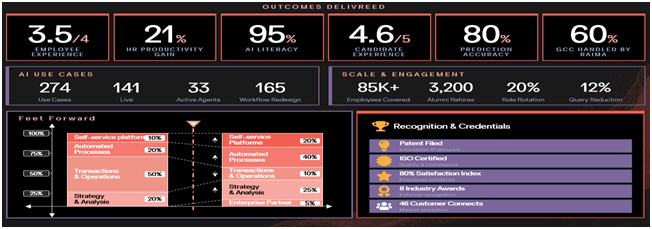
- Overall HR productivity improved by 21%, validated by HR leadership.
- 165+ HR workflows redesigned to reduce manual effort and follow-ups.
Adoption at Scale
- 82% adoption of AI-assisted goal setting within the first month.
- 500,000+ queries resolved with 75% positive satisfaction.
- 66,000+ policy lookups per month (sustained self-service behaviour).
- 90% digital onboarding adoption; 81% offboarding portal usage.
- 141 AI use cases live across HR, supported by 33 active agents.
- AI literacy reached 95% within the HR community, driven by structured enablement, hackathons, and hands-on adoption.
- 85,000+ employees now covered through AI-enabled HR journeys.
Cycle Time Reductions
- 75%+ reduction in goal-setting effort.
- 85% reduction in recruiter manual workload.
- 10% shorter time-to-hire; 7% increase in offer acceptance.
- Response times improved from days to seconds for HR queries.
Employee and Candidate Experience
- Employee experience stabilised at 3.5/4 , with consistent feedback on faster response times and easier access to HR support.
- Candidate experience reached 4.6/5 , reflecting improvements in hiring and onboarding journeys.
- 4.5/5 recruitment, onboarding, and overall HR self-service experience ratings.
- 75% satisfaction for always-on HR support.
Business and Talent Outcomes
- 3,200+ alumni rehires , supported by AI-enabled alumni engagement and re-entry journeys.
- Predictive models achieved 80% accuracy, giving HR and leaders earlier signals for workforce decisions.
External Impact and Credibility
- 6 packaged HR AI offerings launched, based on learnings from the internal transformation.
- Multiple customer conversations initiated, positioning HR as a credible transformation partner.
- Influenced large deals and consulting engagements.
- Case studies published by Microsoft and ServiceNow on their websites, validating the work beyond internal forums.
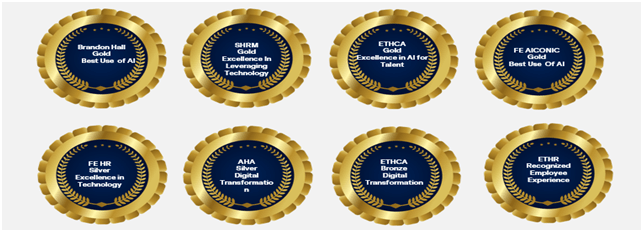
- 8 HR Transformation Awards (Brandon Hall Gold, SHRM Gold, ETHCA Gold, FE AICONIC Gold, AHA Silver, and others).
- ISO and EY audit certification for responsible AI governance; patent filed for RAIma, in India.
| Dimension | Before | After (AI-Enabled) |
| HR Service Delivery | Queries accumulated in inboxes; slower response cycles | 500,000+ queries resolved with 75% positive feedback; response times improved from days to seconds |
| Performance Cycle | High manual follow-ups for goal setting | 82% adoption of AI-assisted goal setting in 1 month; >75% reduction in time and effort |
| Talent Acquisition | Recruiters spent heavy time screening | 85% reduction in manual workload; 10% shorter time-to-hire; 7% increase in offer acceptance |
| HR Bandwidth | Capacity absorbed by repetitive administration | 37,000+ annual hours saved (onboarding); 4,915 hours (offboarding); 0.5 to 0.75 person-months in performance management |
| Employee Experience | Multiple systems; employees waited for clarifications | 66,000+ policy lookups per month; 4.5/5 self-service rating; 4.5/5 recruitment and onboarding rating |
| Decision-Making | Fragmented reporting, delayed insights | AI-enabled nudges, dashboards, faster goal-setting; predictive models at 80% accuracy |
6. Key Learnings and Recommendations
What Worked
Co-creation with users: Design Thinking Workshops, focus groups, and early prototype testing helped surface real friction points, increased ownership, reduced resistance, and accelerated adoption.
Focus on trust and adoption, not just features: Adoption improved when AI was consistently positioned as a coach and assistant (not an evaluator), with step-by-step enablement and in-the-flow nudges.
Deliver quick wins, then expand iteratively: Value was delivered in iterative waves (agile sprints), using early wins to build momentum. The platform then expanded through phased rollout and continuous refinement based on telemetry, satisfaction metrics, and error patterns.
What Did Not Work (and What Had to Be Corrected)
Early-stage technical complexity and rework: Fragmented system interoperability challenges and data inconsistency required improvements in grounding, prompt engineering, load balancing, and UX redesign.
Treating AI as a separate layer: The breakthrough came from integrating AI directly into lived workflow moments (such as performance cycle steps) rather than positioning AI as a standalone analytics layer.
Underestimating the organisational change load: HR processes were human-centric and not yet optimised for AI-driven interactions, creating adoption barriers until champions, training interventions, awareness campaigns, and updated guidelines were introduced.
Top Recommendations for HR Leaders
- Anchor AI to real HR problems, not AI possibilities. Start with measurable pain points (cycle time, query volume, completion bottlenecks, inconsistent experience) and design AI interventions against those.
- Design for humans first (workflow-first, not tool-first). Use co-creation and design thinking to ensure solutions match how employees, managers, and HR teams actually work. Embed AI into the flow of work and keep humans accountable for decisions.
- Treat trust as a design requirement. Build a clear operating boundary: what AI can do, what it cannot, when it escalates to humans, and how decisions remain explainable. Establish ethics principles and governance early so scaling does not create risk debt.
- Measure relentlessly (usage, outcomes, and experience). Track adoption and experience continuously through dashboards, pulse and feedback loops, and structured review forums. Segment outcomes by function and persona so you can refine what works and stop what does not.
- Plan integration and change management as core workstreams. Expect integration complexity (legacy interoperability, platform transitions) and adoption barriers. Mitigate with phased rollout, structured enablement, champions, and ongoing communications.
Conditions for Success
- Executive sponsorship and CHRO ownership of the AI vision.
- Organisational readiness assessment before deployment.
- Dedicated change management and enablement budget.
- Cross-functional teams combining HR, IT, and data science.
- Clear data governance and responsible AI principles from day one.
7. Closing Thoughts
ReimAIgine HR at LTM demonstrates that AI-led HR transformation is not about replacing HR. It is about making HR faster, more consistent, and more human at scale.
The journey started with a clear problem (fragmented systems, manual effort, delayed insights, inconsistent experiences) and a clear philosophy (AI as co-pilot, not replacement). It was built on strong foundations: governance, co-creation, maturity assessment, and function-wise enablement. It delivered measurable outcomes, including 21% HR productivity gain, 82% goal-setting adoption, 95% AI literacy, 60% GCC handled by Super Agent RAIma, and 4.5/5 experience ratings.
But perhaps most importantly, it positioned LTM as more than an internal transformation story. By building with rigour and replicability, the ReimAIgine HR team created packaged offerings, engaged 46 customers, influenced 4 large deals, delivered 2 consulting engagements, and earned external recognition through awards, certifications, and case study publications by Microsoft and ServiceNow.
For CHROs and HR leaders considering AI-led transformation, the LTM experience offers three core takeaways:
- Build for outcomes, not features. Anchor every AI initiative to measurable HR problems: cycle times, experience gaps, decision delays. Communicate value through before-and-after evidence.
- Embed trust and governance from day one. Human-in-the-loop design, policy-grounded boundaries, and responsible AI principles are the foundation for enterprise-wide adoption and long-term credibility.
- Think beyond internal transformation. When built with replicability and rigour, internal AI journeys can position HR as a strategic consulting partner, creating value not just within the organisation but for customers and the broader market.
AI-first HR is not a destination. It is a continuous evolution. The journey continues.
About the Authors
HR Transformation Team, LTM Limited
LTM’s HR Transformation team drivesworkforce transformation initiatives across 87,000+ associates in 41 countries. The team pioneered the ReimAIgine HR programme, building one of the most comprehensive AI-led HR transformations in the IT services industry. Their work has been recognised by Brandon Hall, SHRM, ETHCA, FEHR, Microsoft, and ServiceNow, and has evolved into a suite of customer-facing AI-powered HR offerings.
Contact: Radhika.Maheshwari@ltm.com