
Posted on June 11, 2026 | Aniruddha Donge
As organizations increasingly embrace automation, the conversation is shifting from AI merely replacing tasks to how collaborative AI systems can work with humans to enhance productivity, decision-making, and workplace efficiency. The real game-changer here is Agentic AI.
It’s not just about following rules – it learns, adapts, and steps in to help people with their work. Instead of just following routine tasks, it proactively works alongside humans to make their jobs easier across all business domains. This is called collaborative intelligence – combining human and AI capabilities to improve task performance.
What is Collaborative AI?
Collaborative AI refers to the strategic partnership between human intelligence and artificial intelligence (AI) systems. This collaboration aims to harness the unique strengths of both entities to achieve superior outcomes.
By integrating human creativity, critical thinking, and contextual understanding with the speed, precision, and data-processing capabilities of AI, businesses can tackle complex challenges more effectively. Human–AI teaming is essential in workplaces where AI technologies and human intelligence must work together to achieve common goals.
In this symbiotic relationship, AI systems handle repetitive and mundane tasks, allowing human workers to focus on higher-level strategic activities. For instance, while AI algorithms can quickly analyze vast amounts of data to identify patterns and generate insights, human intelligence is crucial for interpreting these insights and making informed decisions.
Human–AI teams are becoming increasingly important as businesses seek to leverage the strengths of both humans and AI systems to tackle complex challenges. This collaborative approach not only enhances productivity but also fosters innovation, as both humans and machines bring their unique strengths to the table.
Background: History and Growth of AI in Business Process
Over the past seven decades, AI’s role in business processes has evolved from fully human-controlled early computers in the 1940s–50s, to the 1960s–70s vision of “augmented intelligence” where systems supported (not replaced) expert decisions, followed by 1980s rule-based expert systems that worked well but were brittle outside narrow domains. In the 1990s, expanding automation sometimes pushed people into passive monitoring roles, exposing risks of over-reliance and prompting the 2000s “human-in-the-loop” approach in which humans trained, labelled, and corrected machine-learning systems used in areas like search and spam detection. During the 2010s, collaboration became more adaptive as AI continuously learned from user behaviour and by around 2017 evidence showed that human–AI teams often outperform either working alone, popularizing hybrid “centaur” models. Today, generative AI makes collaboration conversational and creative—humans set goals and review outputs—while emerging autonomous agents are beginning to shift human involvement again toward directing and governing AI that can plan and execute multi-step workflows end to end
Key Elements of Human–AI Collaboration
- Tasks: The nature of work determines collaboration, ranging from decision-making and creative problem solving to repetitive and data-intensive tasks. Dynamic task allocation allows responsibilities to shift in real-time according to context and agent capabilities.
- Goals: Shared objectives align human and AI contributions. Individual goals (e.g., AI accuracy, human learning) converge toward collective goals such as efficiency, innovation, and strategic impact.
- Interaction: Communication mechanisms, feedback loops, and interpretability are critical for mutual understanding and coordination. Explainable AI (XAI) enhances transparency and trust.
- Task Allocation: Proper assignment requires recognizing the distinct strengths of humans versus AI: judgment, creativity, and oversight for humans; computation, pattern recognition, and scalability for AI.
Human–AI Collaboration Frameworks
1. Task-Based Models (Frenette, 2024; Saiwa, 2025)
- Augmented Creativity: AI assists human ideation and content generation. Humans retain oversight, ethical validation, and refinement of outputs.
- Applications: Marketing campaigns, product design, content creation.
- Example: Adobe Firefly + creative workflows (2024)
- Hybrid Decision Systems: AI provides predictive insights and scenario modeling; humans exercise strategic judgment and final validation.
- Applications: Financial risk assessment, supply chain optimization, personalized customer interactions.
Example: JPMorgan Chase (COiN + credit risk) — 2024
- Applications: Financial risk assessment, supply chain optimization, personalized customer interactions.
- Oversight-Driven Automation: Humans supervise AI-driven automation, intercept anomalies, and enforce ethical compliance.
- Applications: Quality control in manufacturing, fraud detection, regulatory monitoring.
Example: BMW — AI-powered quality inspection (2024)
- Applications: Quality control in manufacturing, fraud detection, regulatory monitoring.
2. Mode-Based Models (Arxiv 2024; Decision Lab, 2025)
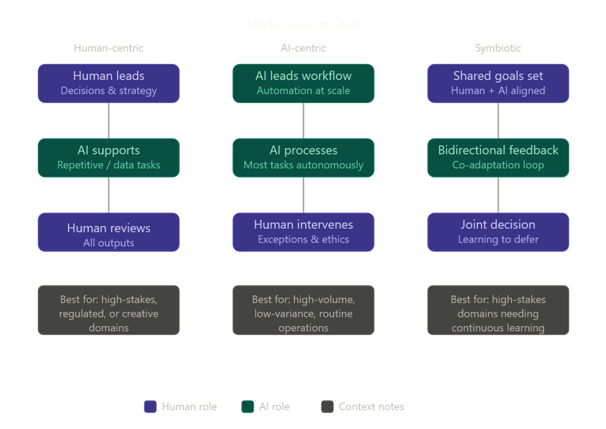
- Human-Centric: Humans dominate decision-making; AI operates as a supporting tool for data-intensive or repetitive tasks.
Example: Mayo Clinic — AI-assisted radiology (2024) - AI-Centric: AI leads most of the workflow; humans intervene for exceptions, ethical oversight, or strategic decisions.
Example: Amazon fulfillment centers — robotic orchestration (2024) - Symbiotic: True partnership with bidirectional feedback, shared decision-making, and continuous co-adaptation; exemplified by “Learning to Defer” strategies in high-stakes domains.
Example: DeepMind AlphaFold + structural biology labs (2023–2025)
3. Interaction and Agency Models
- Agency: Control can be human-driven, AI-driven, or shared dynamically. Dynamic negotiation allows distribution of authority based on expertise and context.
Example: Tesla Autopilot — shared and shifting agency (2024) - Interaction: Includes intent communication (guidance, exploration), feedback (explicit/implicit), and social signalling for trust calibration.
Example: GitHub Copilot — developer–AI interaction loop (2024) - Adaptation: Continual co-learning and role adjustment via reinforcement or iterative updates ensure evolving collaboration effectiveness.
Example: Duolingo Max — adaptive language learning (2024–2025)
4. Classification by AI Type
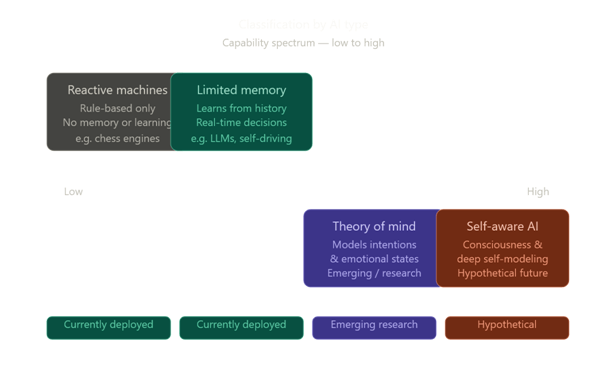
- Reactive Machines: Rule-based, no learning capabilities.
Example: IBM Deep Blue–era chess engines in tournament adjudication - Limited Memory AI: Learns from historical data for real-time decisions.
Example: Spotify Discover Weekly — personalized recommendation (2024) - Theory of Mind AI: Emerging systems that model human intentions or emotional states.
Example: Woebot — AI mental health companion (2024–2025) - Self-Aware AI: Hypothetical future systems capable of consciousness or deep self-modelling. There is no commercial deployment as of 2025
Mechanisms for Effective Human–AI Teaming
- Role Differentiation: Assign tasks according to inherent strengths; mirrors human team dynamics.
- Trust Calibration: Iterative adjustment to prevent over/underreliance on AI insights.
- Complementarity and Sequencing: Human judgment for novel exploration; AI for scaling or refining solutions.
- Transparent Feedback: Behavior descriptions, error disclosures, and rationale explanations improve predictability and ethical compliance.
- Memory and Context: Persistent contextual knowledge (Contextual Memory Intelligence) fosters longitudinal coherence and regulatory accountability.
Where Human–AI collaboration shows up
Human–AI collaboration is already embedded in day-to-day enterprise work. The pattern is familiar: systems surface drafts, options, or classifications at scale; people supply intent, context, and accountability before anything consequential reaches a customer, a regulator, or production.
- Engineering and IT
AI assists with pull-request summaries, test suggestions, log clustering for incidents, runbook drafting from tickets, dependency or license questions, and security-finding triage. Humans still own architecture trade-offs, merge decisions, Sev-1 judgment, and what ships to production. - Customer support and success
Triage by topic and urgency, suggested replies grounded in the knowledge base, multilingual first drafts, and “similar past cases” for agents. Humans handle exceptions, angry or vulnerable customers, policy gray areas, and anything that could create legal or reputational exposure. - Sales and marketing operations
Account research briefs, meeting-prep notes, campaign copy variants, and segmentation ideas from CRM signals. Humans align messaging to brand, consent rules, and factual claims about products and competitors.
- Financial risk and operations
Draft exception narratives, preliminary exposure views, reconciliation anomaly lists, and “what changed” summaries across reports. Humans set limits, approve exceptions, interpret policy, and remain accountable for submissions and sign-offs.
- Compliance, legal, and audit
Mapping controls to requirements, first-pass policy change impact notes, evidence collection from tickets and configs, and contract clause comparison (with strict human review). Humans own interpretations, regulatory filings, and privileged judgment.
- HR and talent
Structured intake of applications against role criteria, interview scheduling, and onboarding checklists. Humans own anti-discrimination practice, privacy, final hiring decisions, and how AI is used in high-stakes steps.
- Product, analytics, and strategy
Natural-language questions over metrics, draft experiment readouts, persona-informed ideation, and competitive-scan summaries. Humans own causal claims, roadmap bets, and ethical use of user data.
- Supply chain and procurement
Demand or disruption summaries, RFP comparison tables, and supplier-risk snapshots from public and internal sources. Humans negotiate terms, approve spending, and manage supplier relationships.
- Cybersecurity and fraud
Prioritized alert narratives, phishing classification support, and playbook suggestions. Humans own escalation, incident command, and decisions that block users or freeze assets.
Across these domains, the technology differs; the collaboration shape is similar: AI scales reading, drafting, and pattern surfacing; humans scale judgment, ownership, and accountability—especially where errors are costly or irreversible.
Who is accountable when the AI is wrong?
Productivity is an easy AI story. Accountability is harder—and enterprises cannot skip it. When output is wrong, biased, non-compliant, or overconfident, the organization still answers to customers, regulators, boards, and courts. “The model said so” is not a strategy.
Why this is the central question
AI optimizes for plausible continuation—not truth, fairness, legality, or fit with your operating model. The enterprise question is not only whether AI improves throughput, but who owns the outcome when the draft is wrong, and what process makes that ownership visible before harm spreads.
A simple operating model: recommend → approve → execute
Many failures come from blurring three roles. Separating them makes accountability discussable in product, risk, and audit.
-
Recommend
The AI (or AI-assisted workflow) proposes: a classification, draft email, code change, risk flag, hiring rationale, compliance sketch. Accountability is technical and design: data quality, prompt and tool boundaries, monitoring, logging, and clear labeling that this is a recommendation—not a decision.
-
Approve
A named human role (or governed process) accepts, edits, or rejects the recommendation against policy, ethics, and business judgment. “human-in-the-loop” must mean real judgment, not a checkbox. Accountability is professional and managerial: training, authority limits, documented rationale for high-stakes actions, and escalation when AI and expert disagree.
-
Execute
Systems carry out the approved action: merge to production, send the customer email, post the journal entry, update access. Accountability is operational: change control, segregation of duties, rollback, and evidence that execution matched approval.
Who is accountable in practice?
Clarity improves when you name the failure mode, not only “AI was wrong.”
| Failure mode | Who owns it |
| Factual or logical error | The deploying team owns model choice, evaluation, and monitoring. The approver owns the decision to act—approval implies sufficient context to catch typical errors, or explicit risk acceptance. |
| Bias or unfair impact | Shared: data and modeling, product design (who is scored how), and human decisions that adopt or override scores. Governance sets standards; product and business owners own market and workplace outcomes. |
| Non-compliance | Regulators care about the entity’s controls, not the algorithm. Legal and compliance interpretation stay human-owned; AI may assist drafting, but sign-off chains do not move. A hallucinated control or citation usually means verification failed before filing or customer use. |
| Misuse or misunderstanding | Enablement and policy: training, UI cues, prohibited uses, consequences for bypassing review. Leadership owns culture and incentives—especially when speed is rewarded without quality. |
What “accountable” should mean on paper
Useful policies answer: Which actions require approval? By whom? What evidence is retained? What runs only after human-approved rules? Who is accountable if the chain breaks? Vague “we use AI responsibly” avoids the question; named roles, decision rights, and audit trails answer it.
Agentic AI raises the stakes
When agents call tools, open tickets, or trigger workflows, recommendation and execution blur unless gates are explicit: what an agent may propose vs. draft vs. do autonomously, with hard stops for payments, PII, external comms, production deploys, and legal commitments. Accountability then includes system design: who can change autonomy levels, and under what review.
Bottom line: Recommendations can scale with machines. Accountability scales with people and governance—especially where errors are costly, unfair, or non-compliant.
Benefits of Human–AI Collaboration
- Enhanced productivity, decision-making, and innovation.
- Enables humans to focus on high-value cognitive tasks by automating repetitive processes.
- Improves quality and fairness of outcomes by supplementing human contextual reasoning with AI analytics.
- Fosters learning, skill augmentation, and collective intelligence.
Challenges and Considerations
- Cognitive Biases and Anthropomorphism: Risk of misattributing capabilities to AI.
- Scalability: Integrating Human–AI collaboration into large organizational workflows requires modular architectures.
- Ethics and Oversight: Ensuring compliance, fairness, and transparency remains critical.
- Dynamic Adaptation: Continuous co-evolution requires monitoring, adjustment protocols, and training data stewardship.
Skill-building and research opportunities in human–AI collaboration
Human–AI collaboration is not only a deployment topic for engineering and operations. It is a cross-disciplinary problem: how people and institutions work with systems that are fast, opaque in places, and uneven in reliability. That opens space for curriculum, professional development, and research that go beyond “prompt engineering” or model scaling alone.
Why the topic is inherently interdisciplinary
Effective collaboration draws on several fields working together:
- Computer science and engineering — models, agents, tools, interfaces, security, evaluation, and systems that make recommendations traceable and controllable.
- Human–computer interaction and design — workflows, explainability that actually supports decisions, error recovery, and responsible defaults so busy experts do not misread AI confidence.
- Cognitive psychology and organizational behavior — trust, workload, automation bias, expertise development, and how teams divide attention between AI and primary tasks.
- Ethics, law, and policy — fairness, consent, liability, documentation expectations, and sector-specific rules as AI touches decisions about people and money.
- Domain expertise — finance, health, law, education, manufacturing, and public administration supply the constraints that make “good collaboration” mean something specific.
Programs and research agendas that mix these lenses tend to produce more durable guidance than siloed “AI literacy” slides alone.
Skill-building: what learners and practitioners can prioritize
For students and early-career technologists
Foundations in software or data practice, plus explicit training in evaluation (when is a system “good enough” for a workflow?), human factors (how outputs are consumed under time pressure), and governance basics (data handling, logging, approval steps). Capstone-style projects that include a human reviewer role and a failure analysis teach more than benchmark chasing.
For experienced professionals
Skills that transfer across tools: problem framing for agents, critique of generated artifacts (code, text, analyses), risk triage (where AI help is high vs. low risk), and communication with legal, risk, and product so “human-in-the-loop” is operational, not decorative. Leadership development can add decision rights design—who recommends, approves, and executes.
For faculty and trainers
Designing assignments and labs where AI is allowed but constrained (e.g., must cite sources, must show intermediate reasoning, must pair with human verification) mirrors enterprise reality better than blanket ban or blanket reliance.
Research opportunities: Research can advance both theory and practice. Illustrative directions:
- Workflow-level evaluation — measuring team outcomes (quality, latency, rework, incidents) when AI is embedded in real processes, not only model accuracy on static datasets.
- Human–AI teaming interfaces — designs that reduce automation bias, support appropriate skepticism, and make uncertainty and limits visible without overwhelming experts.
- Accountability and audit — what evidence chains (inputs, versions, approvals) are needed for regulators, auditors, and internal review when recommendations come from models or agents.
- Agentic systems and control — boundaries on tool use, escalation rules, and “stop” conditions before irreversible or external-facing actions.
- Fairness and impact — downstream effects when AI assists hiring, credit, triage, or student support; methods for monitoring and redress.
- Education — how collaboration skills develop over time, and how curricula should evolve as tools change every year.
Conclusion
Human–AI collaboration is not only a technology rollout challenge; it is a leadership design challenge. The organizations that gain the most are rarely those that deploy agentic systems fastest, but those that decide deliberately where automation should run ahead of human review, where human judgment must stay in the loop, and where accountability must remain with people regardless of how capable the system appears.
Before adopting agentic AI at scale, leaders should answer three questions honestly:
Where do we need speed?Target workflows where faster iteration, broader search, or continuous execution creates clear value—such as routine analysis, first drafts, monitoring, and triage of high-volume signals—without compromising safety or trust.
Where do we need human judgment? Reserve human attention for contexts that demand contextual wisdom, ethical trade-offs, ambiguity, relationship trust, or stakes where errors are costly and hard to reverse.
Where must accountability remain with humans? Define who owns outcomes when AI assists or acts—especially for external-facing decisions, compliance-sensitive actions, and harms that affect rights, safety, or fairness. Agents may propose and execute steps; responsibility for approval, override, and consequences should be explicit.
This future—augmentation, agentic teammates, and new collaboration models—depends on setting clear boundaries. Before adopting agentic AI, decide where you need speed, where human judgment is essential, and where accountability must stay with people; let those answers shape your roadmap, not the model release date.